Texas Wisteria
Wisteria frutescens

- Sun
- Full Sun, Part Shade
- Water
- Prefers moist well drained soil, Moderate
- Mature size
- 15-30 ft tall x 4-8 ft wide
- Best for
- Trellis vine, Pollinator Plant, Native ecosystem plant, Privacy Screen
Gallon — $15 — only 3 left
About this size
- Gallon
- Our standard size: a 1-gallon nursery pot, about 6–7 inches across.
Pay at the nursery, plus 6.75% sales tax. Send your request and we'll confirm availability and your pickup time within 24 hours, then hold your plants. How it works
Planting & care
- Growth habit
- Vigorous, twining woody vine that climbs by twisting stems around a support
- Typical bloom
- Apr–Jun
- Cold hardy to
- Zones 5–9
- Soil
- Moist, well-drained soil; adapts to clay and sandy soils and tolerates wetter ground than most vines
Where to plant
Full sun for the best bloom, though it grows in part shade. Give it a very sturdy arbor, pergola, or trellis, since a mature vine is heavy and twines with real strength. Keep it away from gutters, siding, and small trees it could overtake.
Watering
Water deeply and regularly through the first two summers. After that it does best with moderate moisture and appreciates a soak in long dry spells, though it tolerates wetter ground than most vines.
Cutting back
It blooms on new growth, so prune in late winter to shape the vine and remove tangled stems. A light trim after flowering keeps it tidy and can encourage a scattering of repeat blooms.
Safety
All parts of the plant, especially the seeds and pods, are toxic if eaten. Plant it where children and pets will not chew on the pods.
About Texas Wisteria
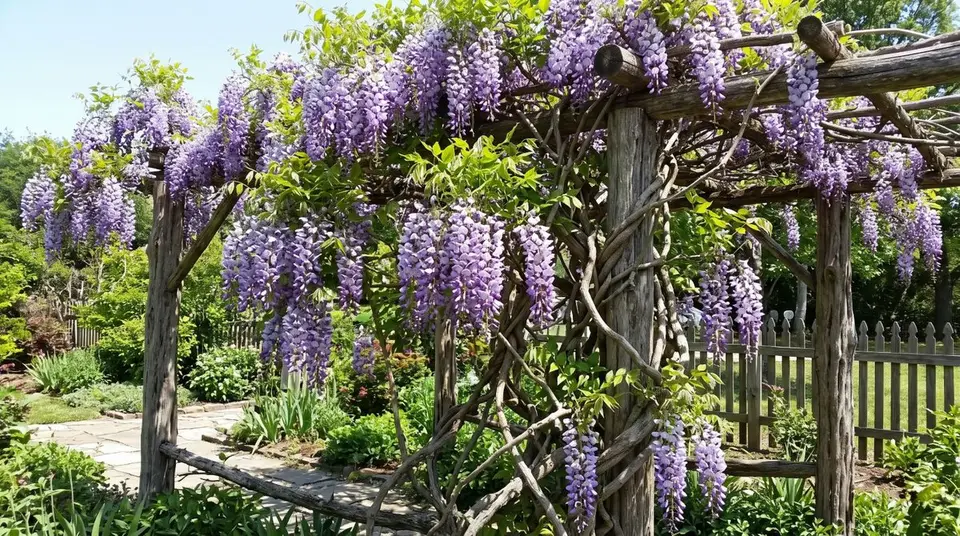
Wisteria has a reputation for spectacle, and the native species delivers it without the bad behavior. Texas wisteria, Wisteria frutescens, drapes an arbor in hanging clusters of lilac-purple flowers in spring, each cluster four to six inches long and lightly fragrant, and the show arrives with the new leaves rather than before them.
It grows wild in moist woods, bottomlands, and along stream banks across the southeastern United States, including East Texas, where it climbs into the canopy by twining its stems around whatever it can reach. In a garden it does the same on an arbor, pergola, or sturdy trellis, forming a leafy screen of glossy, divided leaves that turn yellow in fall.
Because it blooms on new growth, it flowers reliably even after a hard winter or a heavy pruning, which makes it more dependable than the Asian wisterias that can go years without a bloom. Bumblebees and other native bees work the flowers, and skipper butterflies use the vine as a host plant. It is also a legume, so it enriches the soil around it instead of demanding it.
It is a vigorous, long-lived vine that rewards a strong support and a bit of pruning to keep it in bounds. For anyone who wants the romance of a wisteria-covered arbor from a plant that belongs in Texas, this is the one to choose. As with many woodland plants, its seeds and pods are toxic if eaten, so plant it where children will not chew on the pods.
Where it's native
Texas Wisteria occurs naturally in 3 Texas ecoregions — Pineywoods, Post Oak Savannah, Gulf Prairies and Marshes. Plants grown from local ecotypes are best adapted to our soils and climate here in the blackland prairie and post oak savannah.
- 1Trans-Pecos
- 2High Plains
- 3Rolling Plains
- 4Edwards Plateau
- 5Cross Timbers and Prairies
- 6South Texas Plains
- 7Blackland Prairies
- 8Post Oak Savannah
- 9Gulf Prairies and Marshes
- 10Pineywoods