Black Willow
Salix nigra

- Sun
- Full Sun
- Water
- High
- Mature size
- 30-60 ft tall x 30-50 ft wide
- Best for
- Wildlife cover / habitat, Erosion Control, Fast shade tree
Planting & care
- Growth habit
- Upright, irregular, often multi-trunked
- Typical bloom
- Mar–Apr
- Cold hardy to
- Zones 4–9
- Soil
- Adaptable; performs best in loam, clay, or sandy soils with moisture
Where to plant
Full sun, in soil that stays consistently moist — low spots, pond edges, and creek banks are ideal. Keep well away from foundations, septic lines, and water pipes; the root system is aggressive and will seek out moisture.
Watering
Water regularly during establishment. Once rooted in, it tolerates periodic flooding and standing water better than almost any other tree.
Pruning
Responds well to hard pruning. Prune while young to establish a strong structure and encourage straighter growth.
About Black Willow
For anyone with a pond, creek, or low spot that stays wet, Black Willow is one of the fastest ways to get a tree established. Few native trees grow as quickly, and fewer still tolerate standing water and periodic flooding without complaint — it's simply built for the wettest ground on the property.
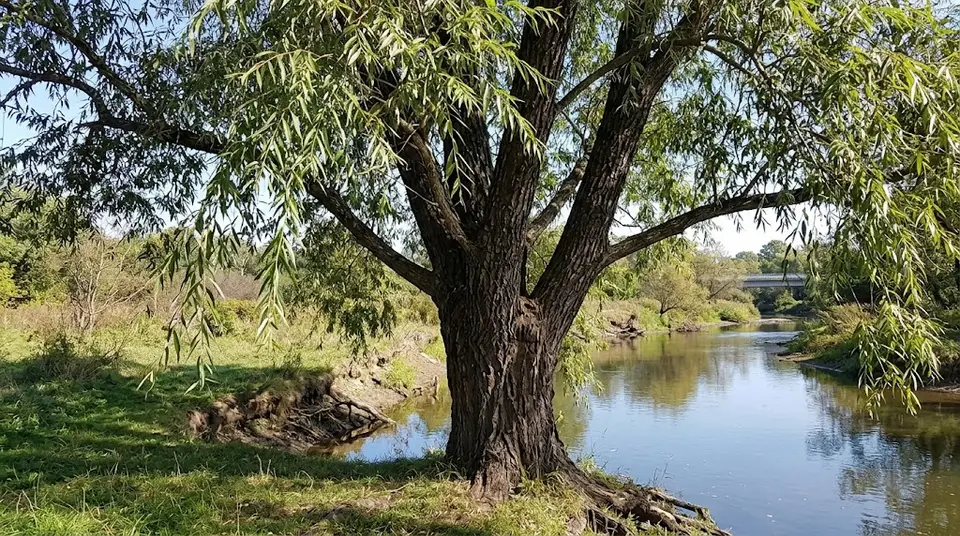
Salix nigra grows into a large, irregular, often multi-trunked tree with narrow leaves that flutter in the slightest breeze and dark, deeply furrowed bark on older trunks. Small yellow-green catkins appear in early spring, opening well before most other trees and offering bees one of the season's first real pollen sources.
The dense, arching branches provide excellent cover for nesting songbirds, and the extensive root system does exactly what the tree is known for: holding soil in place along a bank, pond edge, or drainage. It's a genuine workhorse of the riparian landscape.
This is a tree for acreage and wet ground rather than a small yard — its roots are aggressive and its mature size is considerable — but for restoration projects, pond edges, and erosion-prone spots, few natives establish faster or work harder.
Where it's native
Black Willow occurs naturally in 6 Texas ecoregions — Pineywoods, Post Oak Savannah, Gulf Prairies and Marshes, Blackland Prairies, Cross Timbers and Prairies, Edwards Plateau. Plants grown from local ecotypes are best adapted to our soils and climate here in the Blackland Prairies.
- 1Trans-Pecos
- 2High Plains
- 3Rolling Plains
- 4Edwards Plateau
- 5Cross Timbers and Prairies
- 6South Texas Plains
- 7Blackland Prairies
- 8Post Oak Savannah
- 9Gulf Prairies and Marshes
- 10Pineywoods